
You’re Looking at Venus de Milo the Wrong Way
Everyone notices the missing arms. Almost no one sees what she’s doing.

Most people stop at the missing arms.
That’s the distraction.
Her body is caught mid-adjustment.
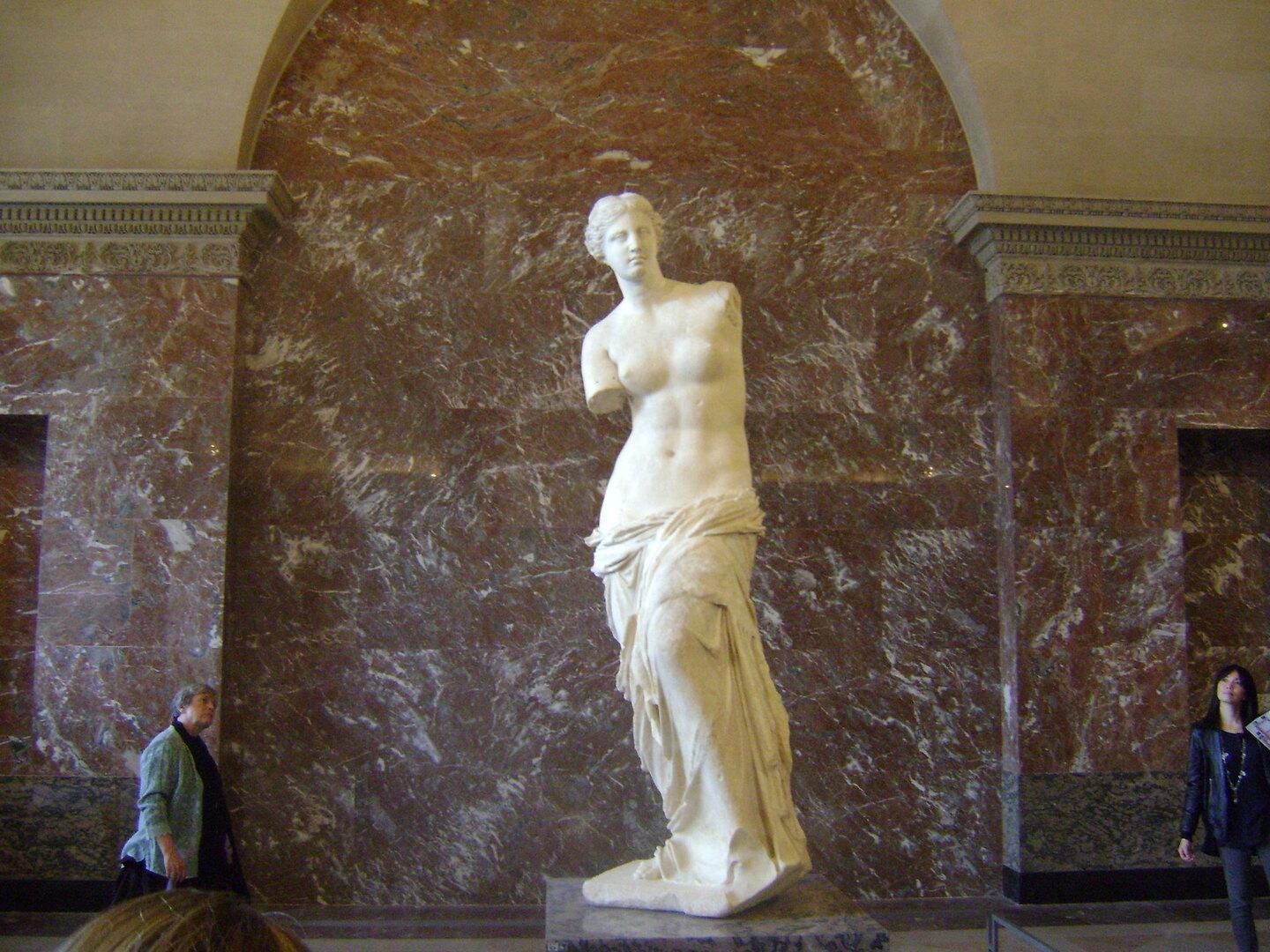
Carved around 100 BCE, Venus de Milo comes from a different world than the earlier, rigid Greek figures.
This is a Hellenistic work.
Less perfection and more tension.
Her weight drops into one leg.
The opposite knee softens.
Her hips push outward, dragging the drapery with them.
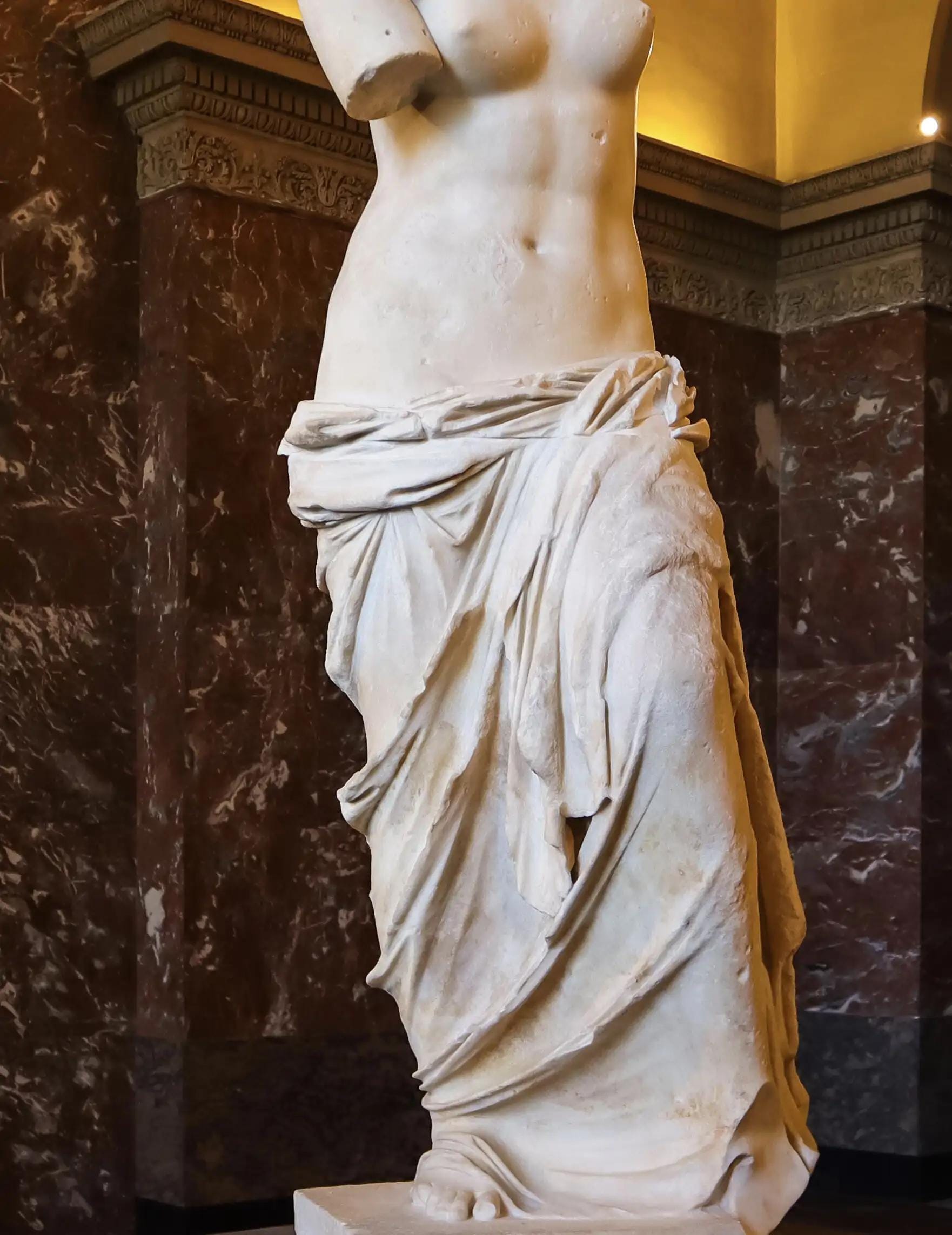
That fabric isn’t decoration.
It’s proof of motion.
It bunches under the hip.
It tightens across the thigh.
It loosens and falls where gravity takes over.
Marble behaves like cloth because the body beneath it is doing something real.
This is what most people miss. I write about these details every week.
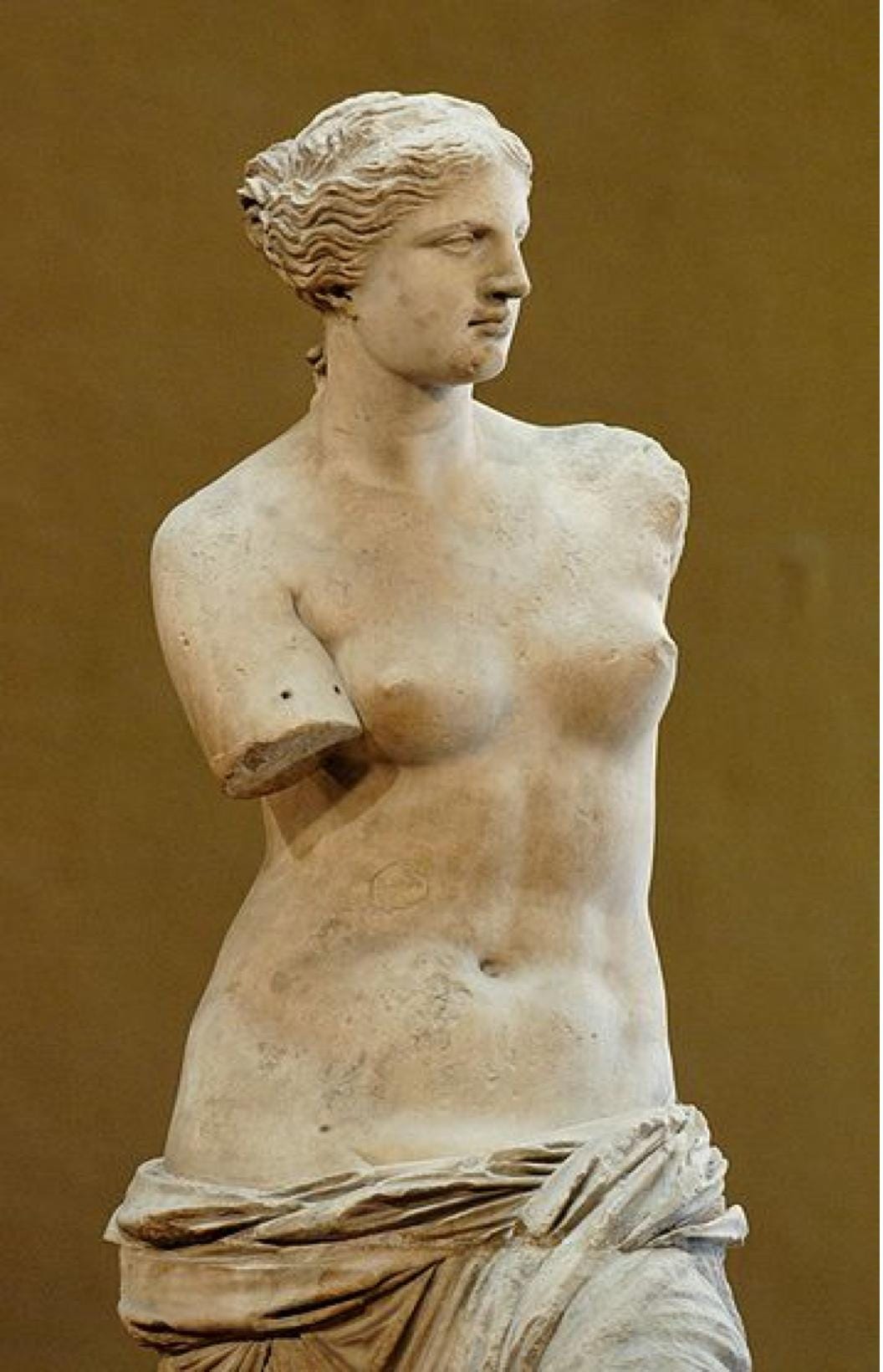
Look at the turn.
Her hips move one way.
Her torso answers in another.
It’s slight.
Easy to miss.
But it creates a body that isn’t posed—it’s adjusting.
Like someone shifting their weight after standing too long.
Or about to step forward without thinking about it.
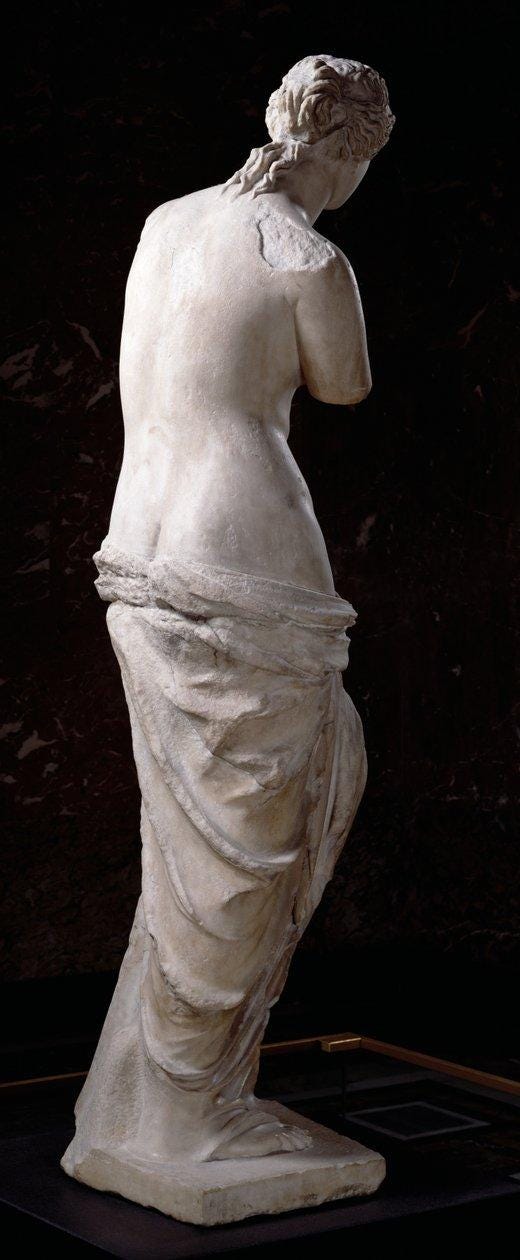
She wasn’t discovered like this — clean, isolated, complete.
In 1820, on the island of Melos, she was found in pieces.
Buried.
Broken.
Separated from her base.
That base mattered.
It had a name - Alexandros of Antioch.
And for a time, that name complicated things.
Because it placed her in a later period — Hellenistic, not Classical.
Not the “pure” Greece people wanted her to represent.
So the name faded from the story.
And the arms?
They weren’t some ancient mystery lost to time.
They were likely damaged and lost around the moment of discovery — during handling, transport, or the scramble to claim her.
There are early accounts suggesting one arm held an apple.
A reference to the Judgment of Paris. Others think she was gathering her drapery.
We don’t know. And that uncertainty pulls us in.
You finish her motion in your mind. That’s part of her power.
Then there’s the surface.
What you see now — white, smooth marble — is not what anyone in 100 BCE saw.
She was likely painted.
Skin tones. Lips. Hair.
Possibly metal jewelry attached.
The eyes may have been filled with color or set with inlays.
Time stripped all of it away.
What remains is structure.
Light and shadow. Form without distraction.
But here’s the part almost no one considers.
Her fame wasn’t inevitable.
It was carefully built.
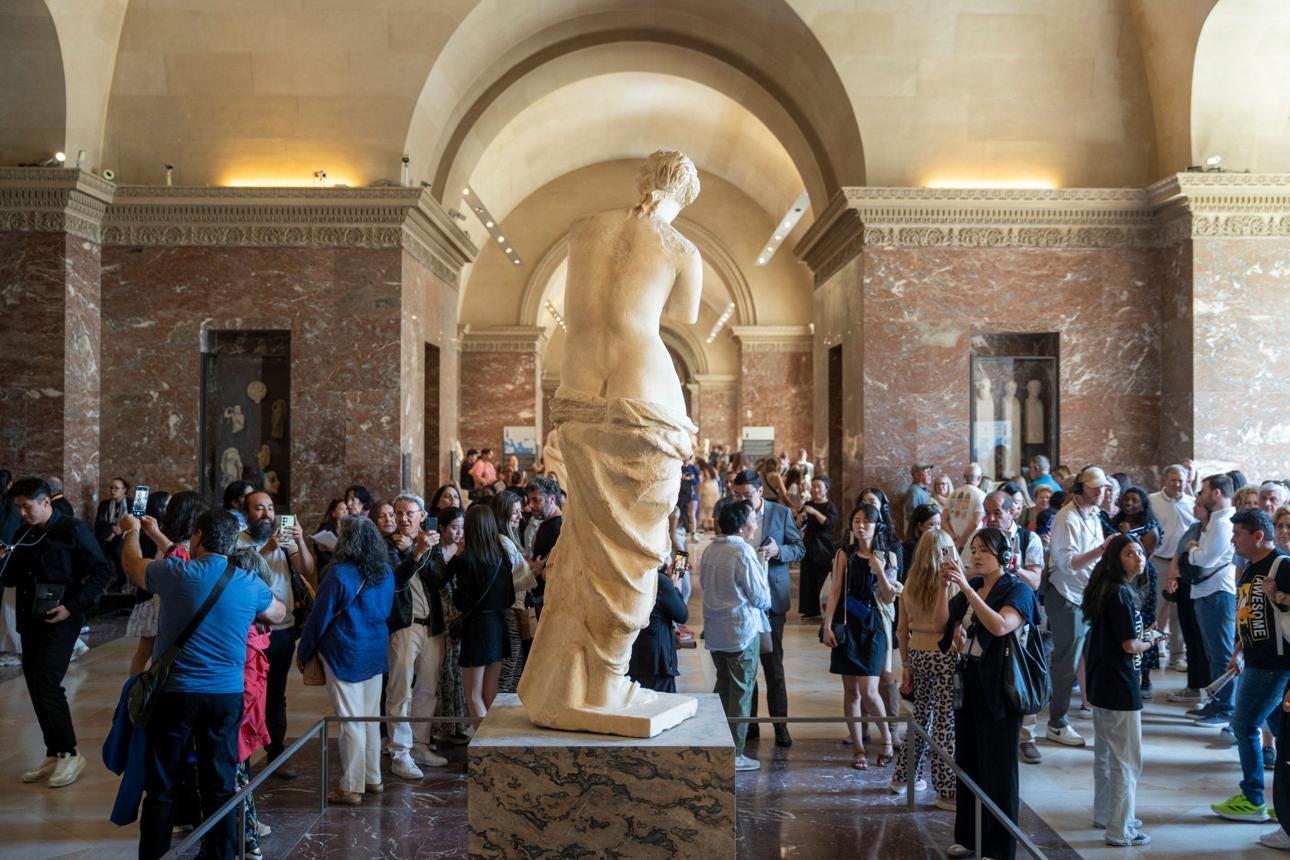
Mona Lisa draws the crowd. Venus de Milo lets you look.
When the Venus de Milo arrived at the Louvre Museum in 1821, France had just lost many of its greatest works after the fall of Napoleon Bonaparte.
The museum needed something to replace them.
Something undeniable.
So Venus was elevated.
Positioned as a masterpiece.
Framed alongside the greatest sculptures ever made.
Even the details that complicated that story were softened or ignored.
And it worked.
She became essential.
Not just because of what she is —
But because of how she was presented.
She stands there now, without arms. Incomplete.
Still adjusting and in motion.
Somehow, she is more alive than statues that were never broken.
Most people walk past these details. You don’t have to.