

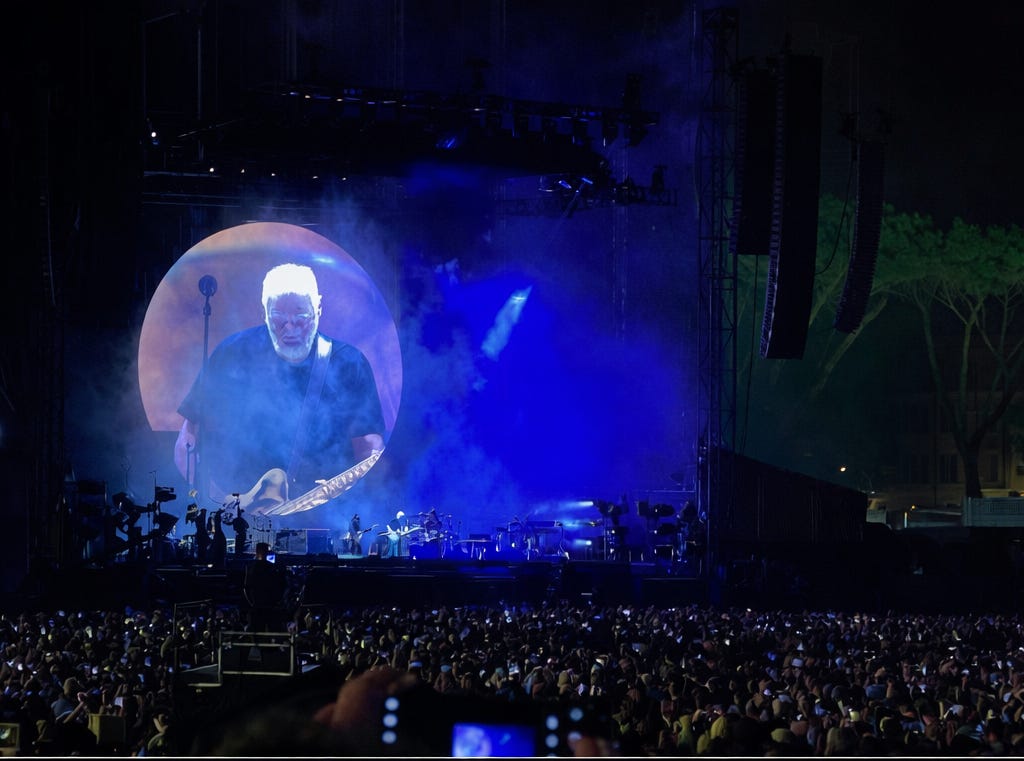
I heard it before I saw anything. A distinctive, bending guitar notes pouring through the late September air near Circus Maximus.
I stopped. My throat tightened. A tear surprised me.
Music stores thoughts and feelings we don’t realize we’ve kept.
Pink Floyd. David Gilmour.
That sound.
It had been thirty years since my ears experienced David Gilmour bend a note like light through marble. I was twenty-four then. I am fifty-four now.
The distance between those two ages suddenly felt measurable — in funerals attended, in voices gone quiet, in empty chairs at crowded tables at holidays.
When I last heard him live in Cleveland’s Municipal Stadium — its rubble now resting on the bottom of Lake Erie, where fish drift through what was once a grandstand —my future stretched wide and unmarked.
My first job. First marriage. First apartment. My life in Russia. So many doors stood open then. Rooms I had not yet entered. Roads I had not yet taken.
In the decades since, many voices have gone quiet.
My mother. Grandparents. Aunts and uncles. Great aunts and uncles. Friends who once stood beside me in crowded arenas and noisy rooms.
Time did what time always does.
In 1994, the horizon felt endless.
In 2024, the horizon feels closer — not closed, but defined.
And yet, David’s guitar.
The same black Stratocaster wailing into the Roman night. The same sustained note hanging in the air, refusing to get on with it. For a moment, twenty-four and fifty-four were the same.
Not everything closes and ends.
Some sounds endure.
David Gilmour has always seemed drawn to places that remember.
He has played beneath the shadow of Vesuvius in Pompeii. Along the water in Venice. Inside the gilded symmetry of Versailles. And in Rome, at Circus Maximus — where chariots once tore across packed earth and emperors measured spectacle.
I’ve noticed something about myself.
When he tours in places layered with history, I keep popping up.
At Circus Maximus in September 2024, Gilmour played five nights. I had tickets for the third.
But the second night, I stood outside the gates and listened from the street.
The sound carried easily — that unmistakable Stratocaster rising into the Roman air. His voice, older and hoarser now, but steady. The bending notes floated over the fence and the ancient stone above as if they belonged.
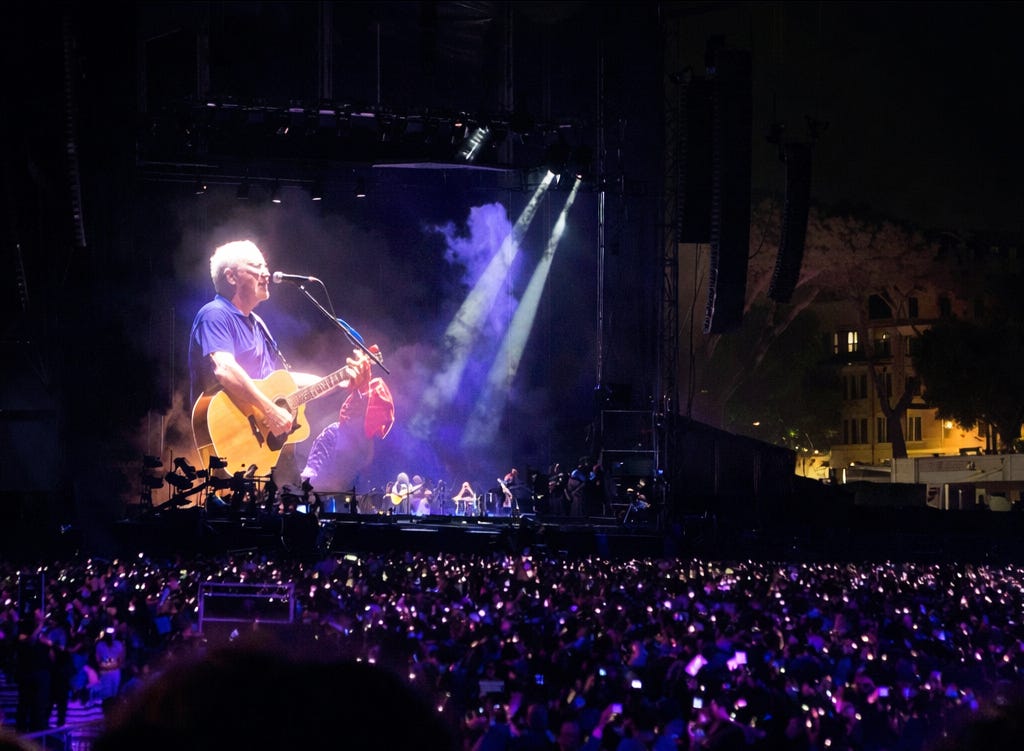
He learned that bend from old American blues records — B.B. King, Muddy Waters, Buddy Guy — stretching a single note until it almost sounded human. No formal training. Just ear, feel, and an obsession with intonation over speed.
Seventy years later, he still doesn’t rush it.
In some ways, standing outside with the mesmerized crowd felt just as meaningful. Italians leaned against ancient stone along the street, quietly absorbing. A young blond woman in shorts and a yellow beanie leaned against a statue fence. Eyes closed. Listening.
No light show. No seat. No program in my hand.
Just stone, night air, and a guitar tone that felt almost unearthly. It was something summoned rather than performed.
The Romans once filled that ground with noise and spectacle.
Now, a single sustained note can quiet a man in his fifties and pull him back thirty years.
Empires fade. Marble crumbles.
But a guitar note, bent just right, can still rule the night in Rome.
Circus Maximus once held over 150,000 spectators — long before concerts, crowds gathered there for chariot races.