
What Dalí Saw From This Window Never Changed
Inside the Studio Where Dalí’s Melting Clocks Began

I stood in Salvador Dalí House-Museum, looking at the sun sparkling on the blue Mediterranean. The studio faces east, so the sun’s first light pours directly through the windows onto the artist’s easel. It is easy to imagine Dalí standing at that same window each morning before beginning his work.
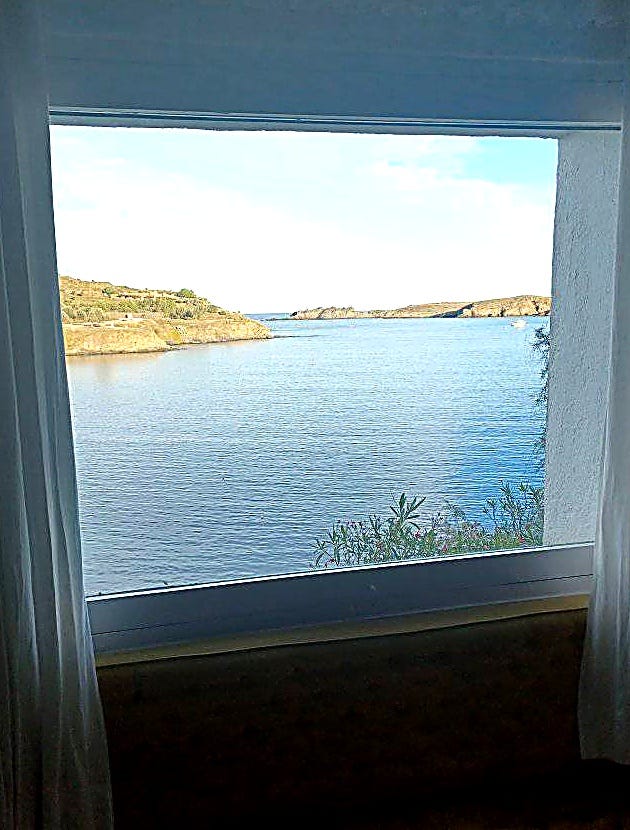
The view from Salvador Dalí’s studio window in Port Lligat.
Through the studio window, the Costa Brava hills rose in uneven folds behind the bay. Brown soil broke through patches of olive trees and scrub.
The land itself had been compressed and heated deep underground millions of years ago as the Pyrenees formed. Wind and sea had since carved the rock into strange, warped shapes — an incubator for Dalí’s imagination.
In the morning sun, the slopes looked dry and rough. Spots of vegetation scattered across the rocky ground, as if they had taken decades of persistent effort in the face of sea wind and Mediterranean light just to survive there.
It hit me. I was not looking at any mere Mediterranean landscape. Before me was the background of some of Dalí’s most famous paintings, such as The Persistence of Memory, created in 1931, and The Disintegration of the Persistence of Memory from 1954.
Dalí said his painting style was the “paranoiac-critical method,” where dream imagery and subconscious associations conjured surreal scenes. Yet the background of much of his art was based on the real Mediterranean landscape — slate and limestone rock, scattered olive trees, and low scrub of thyme and rosemary growing in the dry coastal hills.
He was a remarkable artist, but also a clever marketer at heart. He painted what he thought would sell.
Dalí wanted to paint an object melting in his 1931 masterwork. He noticed one day at breakfast that a wedge of Camembert cheese had softened and melted in the afternoon sun streaming through the window.
The strange image came to him while looking at this very landscape.
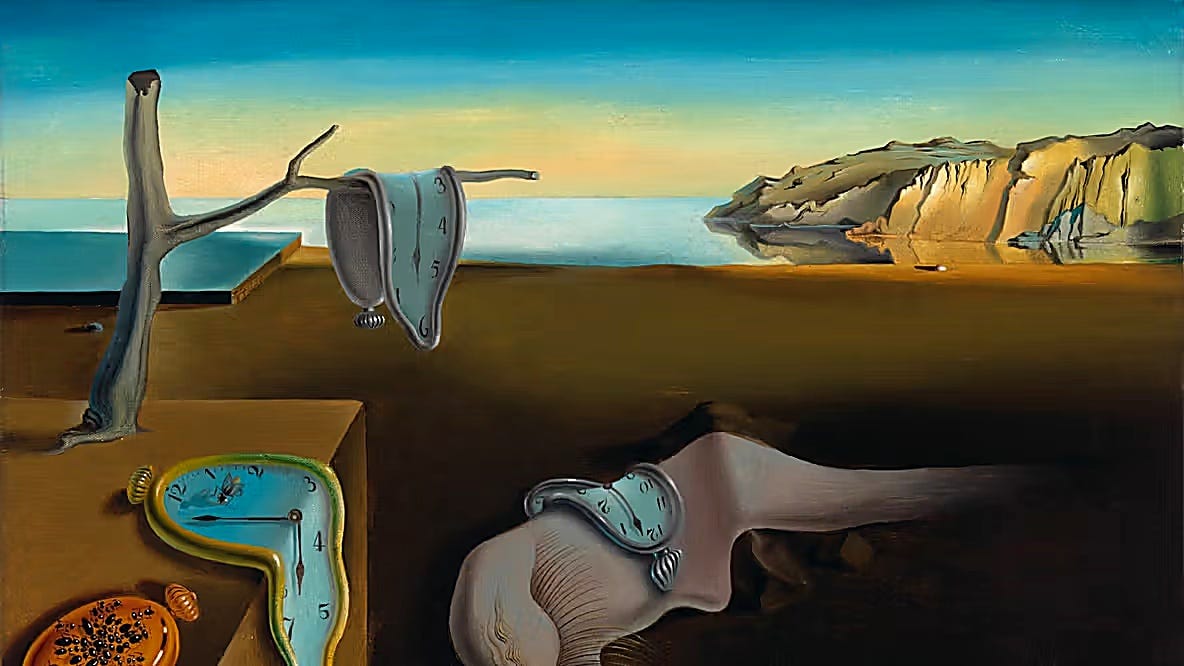
The Persistence of Memory (1931). The coastline resembles the landscape surrounding Dalí’s studio.
That image became the famous melting clock so many of us know, set against the rugged Mediterranean background I had just viewed through the tall studio window.
Even the pale cliffs in the background of The Persistence of Memory resemble the rocky coastline around Port Lligat, just beyond Dalí’s studio window.
Dalí spent thousands of hours in this studio over more than thirty years. The modern master created some of the 20th century’s most famous paintings here — his daily morning view serving as a regular backdrop.
Turning right from the window, I gazed at Dalí’s sparse, white-washed studio walls. On his easel and along the right wall were unfinished paintings he left behind in 1982. His wife Gala Dalí died that year. He was so distraught that he fled their beloved seaside home of forty years and never returned.
The paintings he was composing have never been moved from the positions Dalí left them in. A man who adored his wife so deeply that he left behind his home and refuge forever. Dalí died in 1989, never returning to his Port Lligat studio.
I continued my tour of Dalí’s home, exiting the studio and viewing the living room, sitting room, and kitchen. It had been a tiny, simple fisherman’s cottage when the couple purchased the home in 1931.
As his finances and fame grew, the house expanded. I could see changes in the paint and flooring where additions had been built — a visible record of decades passing.
In one room, the furniture itself formed a painting. Viewed from a specific platform, a sofa, curtains, and a fireplace aligned to create the face of the actress Mae West. Dalí had turned an entire room into a surrealist illusion.
In a corner stood a taxidermied bear holding a lamp in its right paw. A bizarre object, but somehow normal in Dalí’s home.
Stepping outside through the side door, more surrealism met my gaze. Large white eggs rested along the roofline of the house. Dalí often used eggs as symbols of birth and creativity.
Here they sat quietly above the small fisherman’s cottages that made up his home, like ideas themselves had hatched in the golden Mediterranean sun.
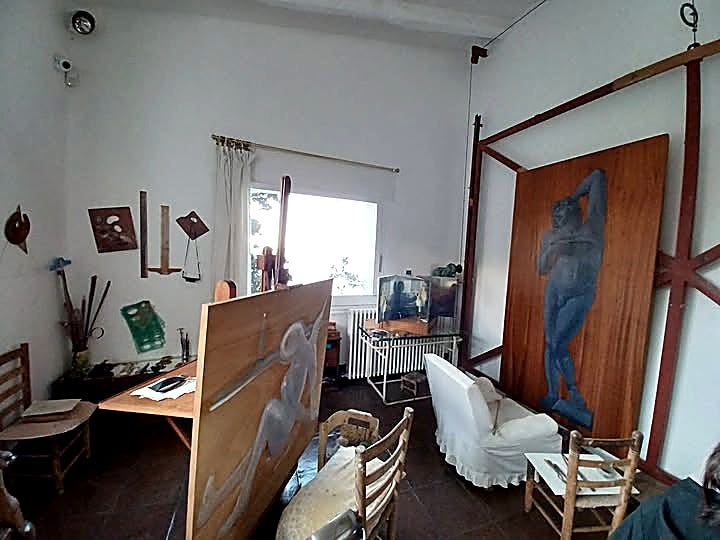
Dalí’s studio interior, with unfinished paintings left where he abandoned them in 1982.
Terraces climbed the hillside in narrow steps and stone paths. Sculptures appeared unexpectedly between the trees. Nothing about the gardens felt unplanned.
As we departed Dalí’s home and museum, I looked again toward his studio window. From that window the artist spent four decades looking out over the same hills, olive trees, and Mediterranean light.
Yet inside that abandoned studio he imagined melting clocks and dreamlike landscapes — a world that existed only in his mind, except for the timeless Mediterranean Sea and the rugged hills he loved.
The same light still pours through that window every morning.
More pieces like this → Unpaid Observer
Do you enjoy short pieces about places where history still lingers? Ancient cities, seaside art studios, and moments where the past is almost within your reach? You can subscribe below.
Dalí placed his easel directly where the morning sun hit the room.
The first light of the Mediterranean would land on the canvas.