

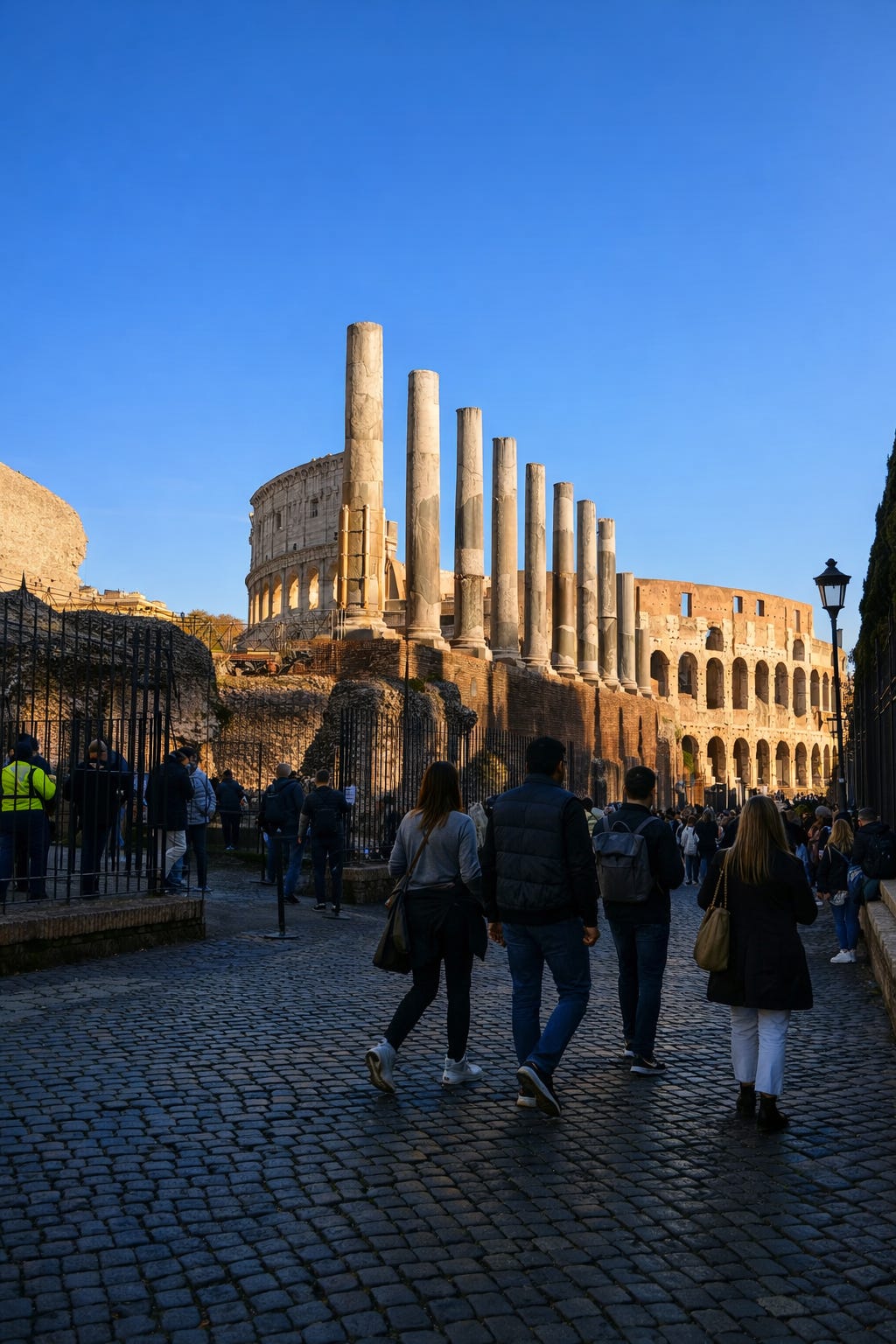
I stood in the Roman Forum in 2023. The columns didn’t feel buried; they felt noble and upright.
White marble against the stark blue Roman sky. Clear lines and balance. Sunlight catches the edges of ancient stone.
One might think of the Forum as preserved. Frozen in time.
But no.
For centuries, roads cut through the center of old Rome.
The Western Empire collapsed in 476 CE. The city fell to the Germanic chieftain Odoacer, who deposed the last emperor, Romulus Augustulus.
As Rome disintegrated and the population shrank, the Forum became pasture.
It was known as the Campo Vaccino — the cow field.
Carts rattled across the uneven ground, hauling spolia — broken columns and reused marble — perhaps hay and grain as well. Over what had once been sacred space, where Julius Caesar, Mark Antony, and Marcus Cicero addressed the city.
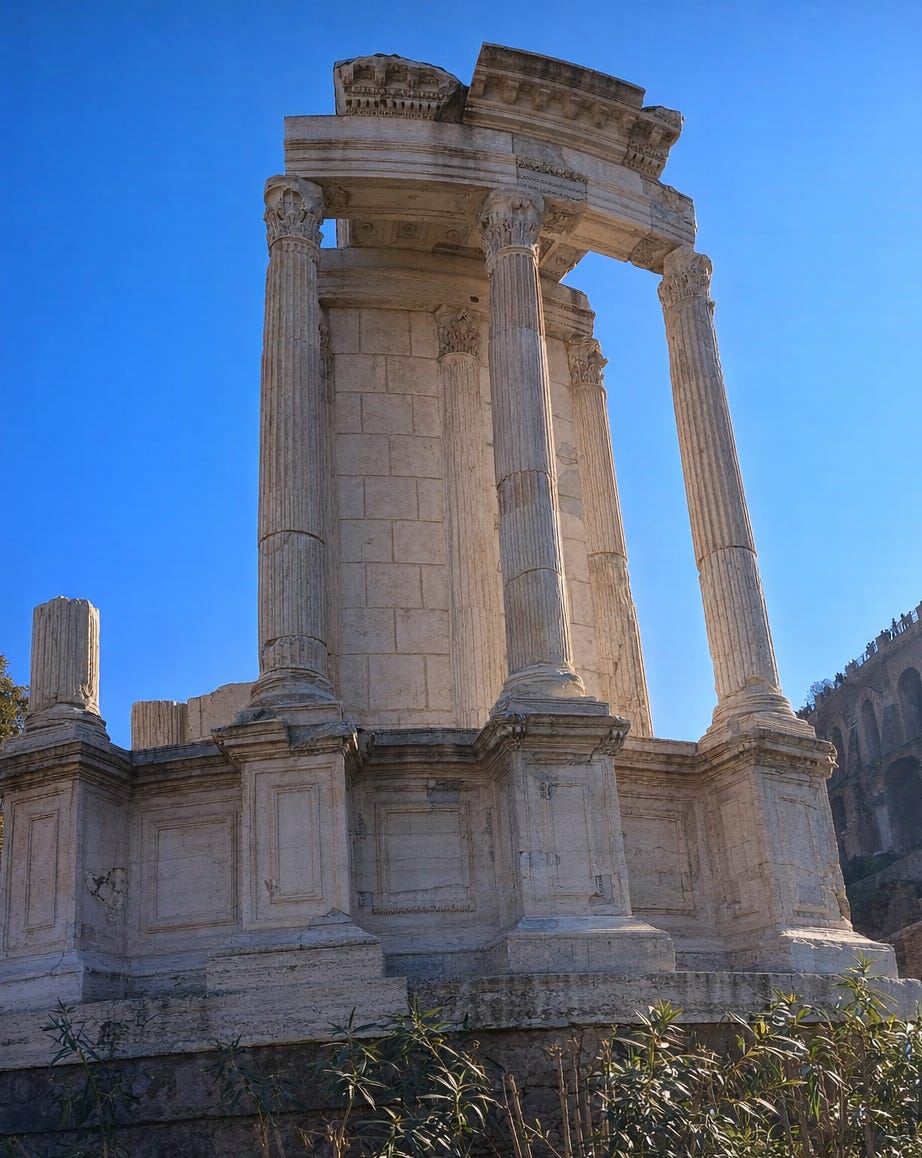
Once colorful, ancient buildings became quarries.
Marble was carried away to construct churches and palaces, including parts of what would become Vatican City. Romans passed through the Forum without ceremony.
It was not destroyed.
It was absorbed by the surrounding city over centuries.
Perhaps that is most unsettling.
Collapse is not always dramatic. It is often gradual. A routine. Like grasses sprouting between ancient stones. Or twentieth-century traffic cutting through what used to be a sacred square.
Until one day, someone decides to unbury it.
In the twentieth century, the clearing became more deliberate. Medieval houses and churches that had grown up among the ruins were torn down under Benito Mussolini, who wanted ancient Rome visible and monumental again — a symbol of imperial strength. Wide avenues were carved nearby. Sightlines were opened. The Forum was not simply uncovered. It was arranged.
I stood there on a chilly December afternoon, looking up at the columns, knowing I wasn’t just seeing Rome at its most powerful.
I was viewing something that survived being ignored for 1,500 years.
Once revered.
Then forgotten and repurposed.
Then paved.
Then excavated and revered again.
Still standing.
Time does not always prevail by brute force.
It waits until someone decides what to remember.
More pieces like this → Unpaid Observer