

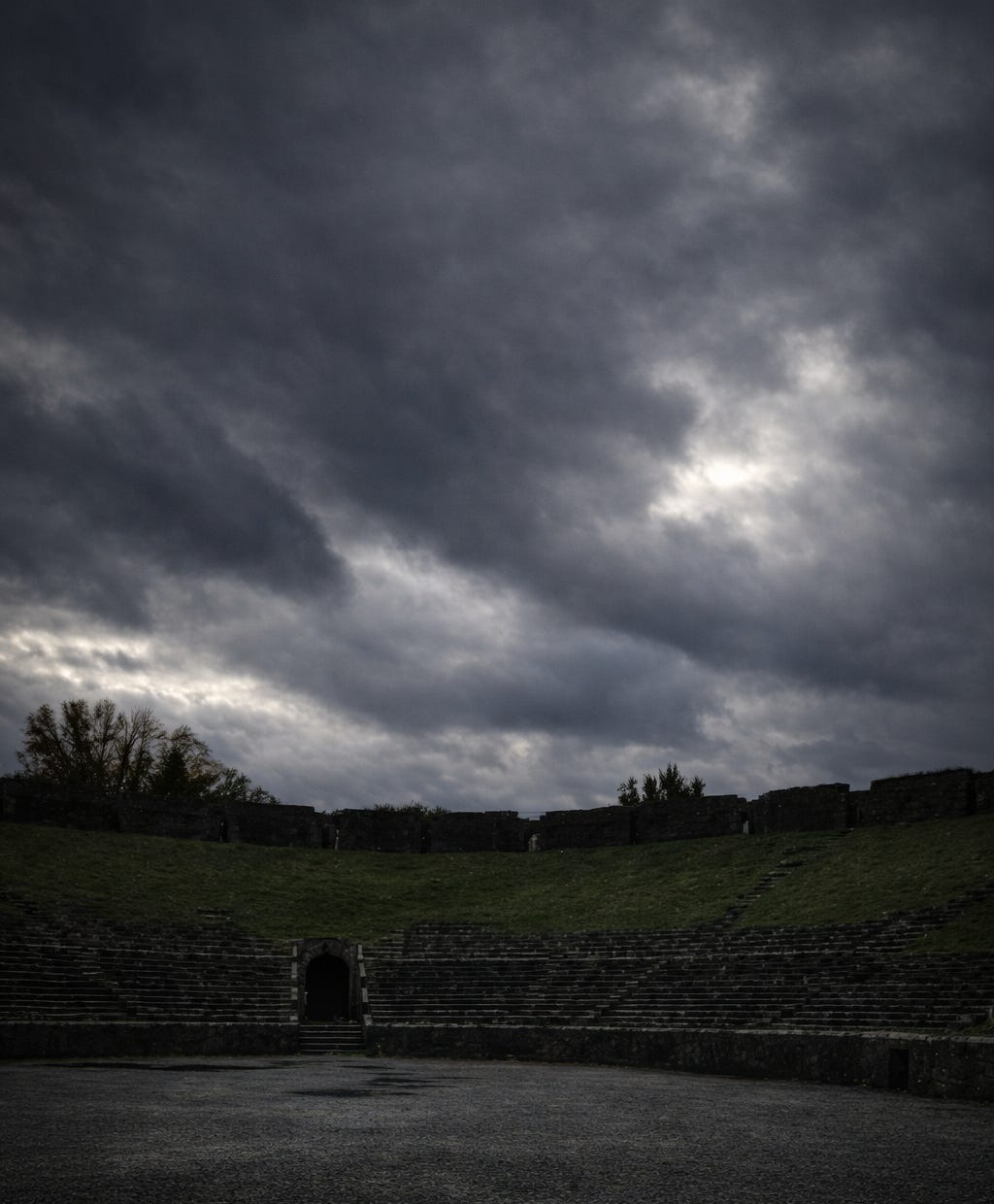
I had thirty minutes in Pompeii in the rain.
Ninety had been allotted for the lost city, and even that felt like a theft. Our group paused for a biology and photo break.
The frescoes were stunning.
But I had something else in mind.
“The amphitheater,” I asked our guide. “Is that on the tour?”
He laughed and shook his head.
“Pink Floyd, right? You’re one of those guys.”
“I am,” I said. “Fanatical.”
“No, my friend. Not on our tour.”
Crestfallen.
In 1972, Pink Floyd filmed Live at Pompeii in the ancient Roman amphitheater — no audience, just four young musicians surrounded by stone that had already endured two thousand years.
A few local kids wandered in, curious. That was it.
History listening to something new.
An anti-Woodstock.
Performing for the past, not for thousands of screaming fans.
Our tour had been remarkable — the Forum, the baths, streets still grooved by cart wheels, plaster casts of those who never made it out. But no amphitheater.
Most people don’t realize how large Pompeii is. The excavated site covers more than four square kilometers. In ninety minutes, you skim. Only highlights.
And even then, you’re only seeing part of it. Roughly sixty-five percent has been uncovered. The rest still lies beneath volcanic ash — streets and rooms sealed in silence.
During the break, our brash Italian guide, curly black hair under a red ball cap, waved me over.
“Listen,” he said solemnly, lowering his sunglasses. “If you don’t go, you’re gonna regret it.”
He pointed toward Mount Vesuvius, hazy and quiet in the distance.
“Follow the main road. One kilometer. Straight toward the volcano. Then sign on the right. Amphitheater. You can’t miss it. Take your photos. Get back here. You have thirty minutes. Go.”
No “if you’d like.” No American politeness or hedging.
Just blunt direction.
I liked the way he spoke to me — as if the choice were obvious and regret was something to be avoided, not debated.
I looked at my wife. I looked at the group. I looked at Vesuvius.
Thirty minutes to choose between ancient Rome and a 1970s band playing to ghosts.
It was a tough call. Roman history is in my bones.
But Pink Floyd?
The guide was right.
Off I went.
I moved double time along the basalt streets laid down before 79 AD, slick with rain and churned mud. The stones were uneven, rutted by cart wheels long turned to dust. I hopped the raised stepping blocks meant to keep worn Roman sandals out of sewage.
Mount Vesuvius loomed ahead — quiet now. Standing watch for millennia silently.
I passed dozens of ancient sales stalls, once piled with olives, rough loaves of bread, and clay lamps blackened by oil smoke.
As I humped along the wet rocks and over the street stepping stones, there were shuttered doorways, faded frescoes, tourists drifting the other direction. I was the only one moving with urgency — chasing a concert that happened 52 years ago in a city buried two thousand years ago.
Ten minutes later I saw the sign and veered right. The path narrowed through olive trees and scrub. The air felt stiller there.
And then it opened.
The amphitheater.
I had watched the 1972 film more times than I could count. I’d bought the VHS in 1990 with money from my grocery-bagging job and worn the tape thin. Four figures standing alone in the dust. The camera circling. The stone holding the sound.
Now the stone was here.
I stepped through the entrance onto the pale gravel floor. It crunched under my shoes. The seating rose in a wide oval around me, mostly empty, a couple visitors high in the shade.
I stood where they had stood.
I could almost see the cables snaking across the ground. Black instrument cases stamped in white - PINK FLOYD. LONDON. The drum kit set against ancient masonry. Amplifiers humming softly before the first note.
No crowd.
No applause.
Just echoes.
“Strangers passing in the street, by chance two separate glances meet…”
Ghosts layered over ghosts — Romans, 70s musicians, a younger version of me rewinding a VHS tape in my parents’ wood-paneled family room.
I raised my phone and took a few photos. A short video. Proof that I had stood here.
The screen glowed in the ancient light. Two thousand years compressed into pixels.
I checked the time.
Ten minutes.
There wasn’t time to linger in Pompeii — not then, not now.
Reluctantly, I turned and retraced my steps, gravel crunching beneath my shoes. Past the olive trees. Back toward the main road. Back toward the living.
When I reached the group, the tour had moved on without me. I’d missed a section, my wife said — the plaster casts of Pompeii’s victims. A highlight for most visitors.
A few sideways glances. Mild confusion at the man who left Roman history to chase a rock band.
I said nothing.
Some choices explain themselves.
Earlier that same day, I had been walking another part of Pompeii — realizing just how large the ancient city really is. I wrote about that walk here.
One thing that surprised me walking through Pompeii was how practical the city was.
The raised stepping stones in the streets weren’t decoration — they let people cross during rain or when sewage ran through the road, while carts rolled between the gaps.