

I stepped to the marble starting line at Olympia.
The dry grass on the hillside smelled warm in the sun.
The grooves were still there. Shallow cuts in the stone where bare toes once pressed into place. I slid my own toes into them, feeling the heat of the marble through the thin soles of my shoes.
I leaned forward in my Modrić jersey, waiting for someone to say, “Go.”
I was about to enter history, running the same 192 meters once run for Zeus.
The race was a stadion — one length of the track, roughly 192 meters. I would run it down and back, for a total of 384 meters. Not far. Not by modern standards.
But this strip of packed earth - sand, dust, river silt, and clay - once held forty thousand men on its grassy embankments. Forty thousand voices rising in Attic Greek, shouting for speed, for glory, for Zeus.
Our guide had smiled at me earlier. “You are a runner,” he said. “You must run it as they did. It is our tradition.”
So I bent at the waist and fixed my eyes on the far end of the track.
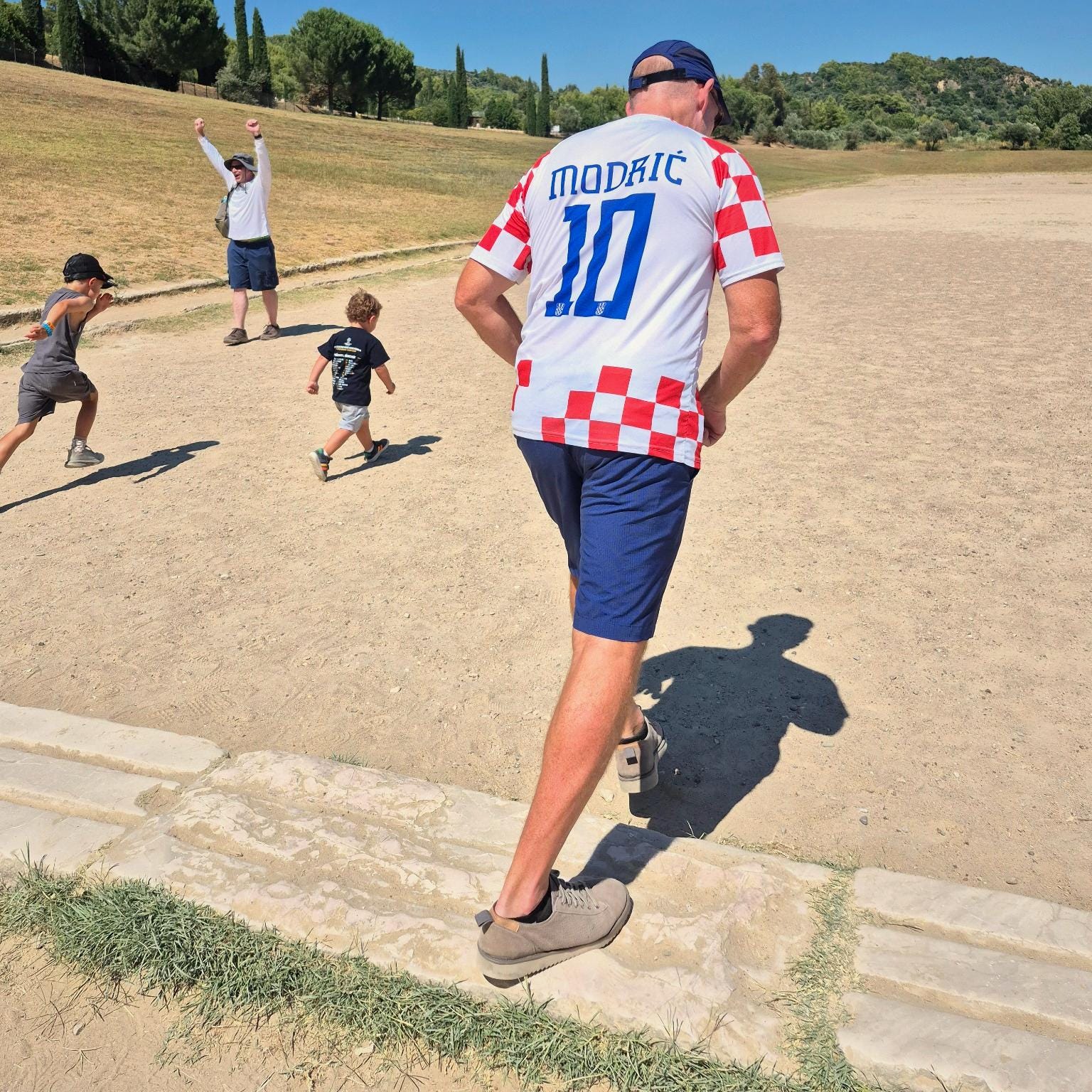
For a moment, there was only the sun, the dust, and the quiet of embankments long gone silent.
Then the silence broke.
I began to run.
My wife and our guide faded behind me. The earth seemed to vibrate beneath my feet. The air changed.
A roar rose from green embankments surrounding the ancient track.
Νίκα! Νίκα!
The word rolled over me like heat. Win. Win.
The embankments were no longer empty. Men in white tunics crowded the slopes, fists raised, mouths open. Dust swirled around bare legs and oiled shoulders. The sun beat down in late summer on bare heads.
I felt the sun on skin that was no longer covered by 21st century synthetic fabric.
My Croatia jersey was gone. I was naked and oiled like the other runners.
A fearsome runner surged beside me — tall, muscular, bronze, slick with olive oil. His shoulder struck mine. Hard. His breath came in ragged gasps. His heel dug into the packed clay just ahead of me. Our bare feet pounded into the dust. Clouds rose higher, obscuring the screaming crowd. Through the dust, I could hear:
Ταχύτερον!
Faster.
Our feet struck the earth and shouting rose around us. It kept rising, hoarse now. Somewhere, a man cried out to Zeus.
I ran on.
The pack of oiled men surged with me, shoulders grazing, elbows jostling one another. We reached the far stone marker at the end of the stadium and pivoted hard, bare feet digging into the dust.
For an instant, the world tilted as I turned.
Then we were running back the way we came.
Looking down the track, the dust obscured the finish line, 192 meters distant. I saw fists pumping and teeth flashing as thousands of men cheered us on.
Golden dust rose higher as we pounded back from where we came. Oil and sweat burned in the sun. The roar from the embankments followed us, chasing us toward the line.
Νίκα! Νίκα!
My lungs burned. The man to my right pulled half a stride ahead. His back was slick, muscles cutting beneath the sheen of olive oil. Another runner clipped my heel, and I stumbled, arms flailing, before I caught myself.
Ταχύτερον!
Faster.
The midday heat pressed down on the crown of my head. My legs felt both ancient and new — mine and not mine. The track blurred. The embankments shimmered and Attic Greek shouts filled my ears. My breath came in ragged gasps. The centuries collapsed into a single, pounding moment in endless time.
The starting line appeared in the dust.
Ahead, the judges stood in white, impassive, watching for the first slick body to break the plane of marble.
I drove forward.
Other runners crossed before me — a shoulder, a chest, a triumphant cry.
My foot smacked the marble.
A rush of white surrounded the victor. Hands lifted him. Someone placed a simple wreath of wild olive upon his head. No gold. No silver. No second place. Only leaves and glory.
And then….
The roar vanished.
The embankments emptied. Empty grass.
The oil dried from my skin.
Wind stirred the dust.
Somewhere behind me, a child laughed and began the same short run I had just completed.
The embankments were bare again. No tunics. No judges. No wreath of olive leaves.
Only dust.
My wife stood beside our guide at the edge of the track, her phone still raised.
“Where did you go?” she said. “I was recording you, and you disappeared.”
The guide lowered his hat against the sun and looked at me carefully.
“You were there,” he said slowly. “Then you weren’t.”
I looked down at my suede shoes.
They were streaked with dust.
A small, ragged olive leaf clung to the left lace.
And a single drop of oil darkened the leather.
The guide checked his watch. “Time for the museum. Our tickets are in fifteen minutes.”
Reluctantly, I walked toward the tunnel, the stone arch rising above us — rock set in place more than two thousand years ago, unchanged by sun or empire.
Inside the arch, the air cooled.
Outside again, heat gathered and the valley lay still.
As we neared the car, I turned back toward the stadium.
For a moment — just once — I thought I heard it.
Ταχύτερον.
Faster.
Then it was gone. There was only wind moving the dust between the empty grassy banks.
The grooves were still there in the marble.
Waiting.
The race wasn’t just sport — it was part of a religious festival for Zeus. The line you’re standing on once marked something sacred.